Thursday, January 24, 2008

Japan's warships resume missions

TOKYO, Japan (CNN) -- The Japanese navy deployed the first of two ships Thursday to resume the country's refueling mission in support of the U.S.-led coalition in Afghanistan, the Kyodo news agency reported.

Japanese supply ship Tokiwa fuels a U.S. Navy vessel, right, in February, 2003, in the Arabian Sea.

The resumption -- which ends a three-month hiatus -- is "indispensable for Japan to fulfill its duty in the international community" and help make Afghanistan more stable, Defense Minister Shigeru Ishiba said at a ceremony held at Yokosuka base, south of Tokyo, according to Kyodo.

The destroyer Murasame left Yokosuka on Thursday for the Indian Ocean, where in about three weeks it will rendezvous with the Oumi, a 13,500-ton support ship. The Oumi is scheduled to leave its base in southwestern Japan on Friday.

The two-vessel task force will include 340 crew members.

As an officially pacifist nation since World War II, Japan's participation in the refueling operation has been controversial. On November 1, Japan's Defense Minister ordered a halt to it, after the government failed to reach an agreement with parliament to extend it.

"It is very regrettable and sad to see Naval Self-Defense Forces stop the mission," Shigeru Ishiba said at the time. "I feel a grave responsibility as the representative of the Defense Ministry."

In the aftermath, government officials vowed to strike a deal to resume the mission. Although the opposition refused to support legislation to re-start it, the government used its majority in the lower house to override, allowing Japan's Maritime Self-Defense Force to resume the mission.

The ships are to provide oil and water for vessels participating in the U.S.-led coalition, Kyodo reported.

About 100 people protested the deployment Thursday morning outside the base in Yokosuka.

Before the break, Japan had been refueling coalition warships in the Indian Ocean since 2001.

Source: CNN.com.

Labels: , , , ,

Monday, November 26, 2007

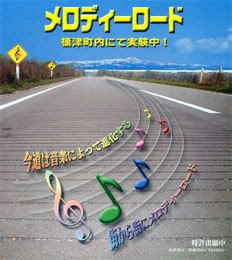
Japan's melody roads play music as you drive

Just after hearing this on Mary Wilson's Drive time show. Sounds like a fun idea. I wonder if you could do like the top 30 on the M7 now that would be fun......Goes off to hum Leona Lewis to the hum of the car wheels. :-D

----------------------------------------------------------------

'Japan's melody roads play music as you drive'

Bobbie Johnson, technology correspondent
Tuesday November 13, 2007

The Guardian

Motorists used to listening to the radio or their favourite tunes on CDs may have a new way to entertain themselves, after engineers in Japan developed a musical road surface.

A team from the Hokkaido Industrial Research Institute has built a number of "melody roads", which use cars as tuning forks to play music as they travel.

The concept works by using grooves, which are cut at very specific intervals in the road surface. Just as travelling over small speed bumps or road markings can emit a rumbling tone throughout a vehicle, the melody road uses the spaces between to create different notes.

Depending on how far apart the grooves are, a car moving over them will produce a series of high or low notes, enabling cunning designers to create a distinct tune.

Patent documents for the design describe it as notches "formed in a road surface so as to play a desired melody without producing simple sound or rhythm and reproduce melody-like tones".

There are three musical strips in central and northern Japan - one of which plays the tune of a Japanese pop song. Notice of an impending musical interlude, which lasts for about 30 seconds, is highlighted by coloured musical notes painted on to the road. According to reports, the system was the brainchild of Shizuo Shinoda, who accidentally scraped some markings into a road with a bulldozer before driving over them and realising that they helped to produce a variety of tones.

The designs were refined by engineers at the institute in Sapporo. The team has previously worked on new technologies including the use of infra-red light to detect dangerous road surfaces.

But motorists expecting to create their own hard rock soundtrack could find themselves struggling to live the dream. Not only is the optimal speed for achieving melody road playback a mere 28mph, but locals say it is not always easy get the intended sound.

"You need to keep the car windows closed to hear well," wrote one Japanese blogger. "Driving too fast will sound like playing fast forward, while driving around 12mph has a slow-motion effect, making you almost car sick."

Source: The Guardian

Labels: , , , , , ,

Friday, November 2, 2007

Hiroshima bomber dies - with no regrets


Hiroshima bomber dies - with no regrets

Reuters | Friday, 2 November 2007

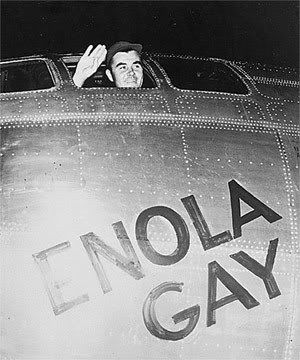
Paul Tibbets, the pilot of the US bomber that dropped the first atomic bomb on Japan on Aug 6, 1945, died on Thursday at age 92, a newspaper reported.

Tibbets, who died at his home in Columbus, Ohio, had suffered strokes and was ill from heart failure, the Columbus Dispatch said in its online edition.

An experienced pilot who had flown some of the first bombing missions over Germany during World War 2, Tibbets was a 30-year-old colonel commanding the Enola Gay, a B-29 Superfortress bomber named for his mother.

After a six-hour flight to Japan, Tibbets' crew dropped the bomb, code-named "Little Boy," over Hiroshima at 8:15am.

"If Dante had been with us on the plane, he would have been terrified," Tibbets said later. "The city we had seen so clearly in the sunlight a few minutes before was now an ugly smudge. It had completely disappeared under this awful blanket of smoke and fire."

The bomb instantly killed about 78,000 people. By the end of 1945, the number of dead had reached about 140,000 out of an estimated population of 350,000.

Three days later the United States dropped an atomic bomb nicknamed "Fat Man" on Nagasaki. Japan surrendered on Aug. 15, 1945, bringing World War 2 to an end.

Tibbets said in interviews he did not regret the decision to drop the bomb.

He became a brigadier general before leaving the military in 1966. Later he was president of Executive Jet Aviation, a Columbus-based international air-taxi service, the newspaper said.


source:http://www.stuff.co.nz/4259151a12.html

Labels: , , , , , ,