Wednesday, November 21, 2007

Doctor struck off after receiving money for 'free' care

In a Follow-up to this story, which Stuff.co.nz reported & listed on here , here is the result of this:
--------------------------------------------------------------

Doctor struck off after recieving money for 'free' care:

An Auckland GP has been struck off after accepting $260,000 from an elderly couple in return for "free" medical care.

Donald Ian McDonald, 62, was struck off the register after being found guilty of professional misconduct by the Health Practitioners Disciplinary Tribunal, a spokeswoman told NZPA.

He was also censured and fined and will have to pay 30 percent of costs incurred by the inquiry. The tribunal also found Dr McDonald had failed to manage the couple's medical care to an expected standard.

Dr McDonald admitted he accepted $260,000 from the elderly couple, who have name suppression, but denied he failed to appropriately manage the couple's health care.

The tribunal heard that the couple paid Dr McDonald in instalments between January 1998 and November 2004. His former de facto partner, who also has name suppression, was paid $60,000.

Dr McDonald had known the couple since he had been administering them with acupuncture in the 1970s but did not become their GP until 1998.

The former partner was ordered to pay back the money in the High Court.

The elderly man died in December last year. His wife is in a rest home and suffers from dementia.

The New Zealand Herald reported that the couple's lawyer, Stephen Gully, told the hearing yesterday he had drawn up wills for the couple and the woman named the doctor as one of the beneficiaries.

However, the elderly man subsequently told Mr Gully he did not agree with his wife's wishes to favour Dr McDonald in the will, preferring instead his nephew.

Source & Contd:Stuff.co.nz


Labels: , , , ,

Wednesday, November 14, 2007

Times Online: I resent her for still being alive

I resent her for still being alive

A reader describes her bitterness, anger and despair at having to care for her mother

As soon as she hears me stir, she calls out, “I could do a wee”, and as I rise my heart sinks. My own day ends right there and I begin another day – as a carer to my 98-year-old mother – by heaving her on to her commode. I hear her use it and then, face averted, take it to the loo and empty it. I bring her teeth; she fumbles in the bowl and pushes them in with a shaky hand. I should help her but I can’t bring myself to touch them.

Later on I make her breakfast, handfeed her and try, in vain, to ignore the dreadful mulching noises as she chews. I look away to avoid seeing her eyebrows wiggle up and down as she sucks from her straw through sunken lips.

I dispense her medication, prop her up on her pillows and switch on the first of those bloody talking books that play throughout the day, blowing away my concentration, peace of mind and privacy.

When I have to move her, endangering my back, I handle her through a towel or her dressing gown because I cannot bear to touch her skin. Everything about her revolts me now and I am ridden with guilt and pity. It’s not her fault. So it must be mine.

How have I ended up like this? What is wrong with me? Why am I like this? At 58, I am one of those awful people who prefer creatures on four legs rather than two, who hasn’t got a caring bone in her body as far as people go. I even avoided having children because I didn’t want to take responsibility for another’s life and I couldn’t face the thought of all the mess involved. Why do I find it so impossible to nurse this needy, wreckage of a human being, who has taken over my life, with a genuinely selfless good heart?

I could do it for the dog. When the animal was old and ill, I tended her with love and kindness and gentleness and never minded clearing up after her; I held her as she died and I wept and grieved. I loved her.

I cannot say the same about my mother and it is the guilt of this that binds me in this living hell.

My mother does not see, with her failing eyesight, the involuntary revulsion on my face when I take her to the toilet. I hope she does not realise, with her still alert mind, how much I resent her for still being alive. She’s had her life and now she’s having mine.

Why not put her in a home? Because with what little remains of my conscience, I have not the heart to consign her with her failing hearing and eyesight and physical frailties to a strange environment that she cannot visualise and doesn’t know, where she will be handled by strangers who she can’t hear or see properly. It’s too late for all that.

District nurses breeze cheerfully in and out of the house, tacitly disapproving of me in my dressing gown at 9am after another disturbed night, dispensing briskness and asuming that I am made of the equal efficiency and ability as they are.

“Here you are,” they say, handing over yet another tube of cream, “you can rub this in at night.”

“No I can’t,” I want to shout. “Don’t you understand? I’m not a nurse, I haven’t got a vocation for this, I haven’t had any training, it revolts me to touch her.”

But instead I nod dumbly and thank them and remind myself to buy some more disposable gloves.

“She’s marvellous, isn’t she?” say visiting relatives admiringly as they depart back to their own normal lives. “No, she isn’t,” I want to shout. “It’s me that’s effing marvellous!”

Few people voluntarily choose to become a carer. For me, as for many, it happened by stealth. I was in denial, hopelessly unsuited to the role, but by doing a bit more and then another bit more for her, I suddenly realised that my life had been taken over completely. I had become, involuntarily and without realising it, a carer. The situation had chosen me; I had no option.

I am occasionally offered “carer away days” when I am given the chance to meet with other carers and take advantage of free (not my italics) “taster sessions” of various alternative therapies and freelunches and tea and coffee to go with it. Oh, wow! Is it only me who finds these offers patronising and insulting? Am I being ungrateful? I am lost in astonishment and real grief that anyone (my italics) can even begin to think that a relentlessly cheerful day spent with other poor exploited saps and being given free anything can in any way at all compensate me for the wreckage of my life. Because that it what it is. It is a self-imposed jail sentence with no time off for good behaviour and no chance of escape........[contd.]


Source:Times.Co.Uk

Labels: , , , ,

Monday, October 29, 2007

It's Charleville!


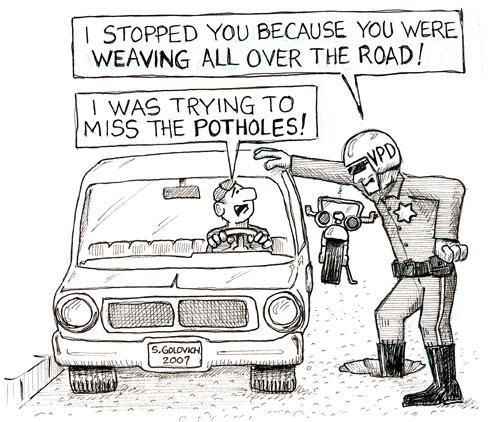
So how many of us have driven through Charleville Co. Cork & recognised how much of a nightmare they're main street is, with some potholes that are so large you could actually loose a car in them. Well despite the fact that Cork Co.Co. has resurfaced the main street in the last number of months, and done a good job on the main street by all accounts, the problem is, I will always think of Charleville as having insane potholes, and also for having about 7 pedestrian crossings within the main street which is less than a 0.03km stretch! ug!

Labels: , , , , ,

Friday, October 12, 2007

The side to Gay Life we don't see: Aging

We never think about it. We go out most weekends; We glam up; We meet our mates; We score some hot young guy; We become the older stalwarts of the community by 25 & jaded by the process and after a couple of months/years out of it, we go back and do it all over again, all in the name of maintaining our view that we are young & continue to be attractive & did I mention young?
The NYTimes this week ran a fantastic article on the concept of growing old as an out gay man and the stigma & prejudice which is attached to this, with regards the provision of care. The article is very well put together, and does in many ways highlight a number of issues in our Society as a whole, the issue of care and whose role is care perceived to be for? It provides a very rude awakening for a culture of young gay men in this country and in most of the Western world where boundaries are broken down, almost on what seems like a daily basis these days. Thought provoking, but will it provide the incentive to do something about it.
------------------------------------------

Aging and Gay, and Facing Prejudice in Twilight

Even now, at 81 and with her memory beginning to fade, Gloria Donadello recalls her painful brush with bigotry at an assisted-living center in Santa Fe, N.M. Sitting with those she considered friends, “people were laughing and making certain kinds of comments, and I told them, ‘Please don’t do that, because I’m gay.’”

The result of her outspokenness, Ms. Donadello said, was swift and merciless. “Everyone looked horrified,” she said. No longer included in conversation or welcome at meals, she plunged into depression. Medication did not help. With her emotional health deteriorating, Ms. Donadello moved into an adult community nearby that caters to gay men and lesbians.

“I felt like I was a pariah,” she said, settled in her new home. “For me, it was a choice between life and death.”

Elderly gay people like Ms. Donadello, living in nursing homes or assisted-living centers or receiving home care, increasingly report that they have been disrespected, shunned or mistreated in ways that range from hurtful to deadly, even leading some to commit suicide.

Some have seen their partners and friends insulted or isolated. Others live in fear of the day when they are dependent on strangers for the most personal care. That dread alone can be damaging, physically and emotionally, say geriatric doctors, psychiatrists and social workers.

The plight of the gay elderly has been taken up by a generation of gay men and lesbians, concerned about their own futures, who have begun a national drive to educate care providers about the social isolation, even outright discrimination, that lesbian, gay, bisexual and transgender clients face.

Source & contd: http://www.nytimes.com/2007/10/09/us/09aged.html?em&ex=1192161600&en=252f4521b8e5d635&ei=5087%0A

Labels: , , , , , ,