Sunday, July 27, 2008

Comments & Updates

Microsoft Word (Windows)Image via Wikipedia
Ok well I do have a reason for not posting as frequently as I have been for the last couple of months. Between family deaths, work and finishing off my Masters, life has been a bit chaotic for the last couple of months. The Masters however (thankfully at last!) currently is sapping most of my free time and my not-so-free time out of my life. However it is a thoroughly enjoyable feeling to have a lead weight around your neck with the pressure that writing a Masters level thesis comes with. NOT! If it was not for the help and support of friends and family I would possibly have gone completly mad at this stage.
So what has the Hedgehog been up to for the last number of weeks? Well he has been pretty busy in work and he has been busy thesising it. Whilst also enjoying looking out at the sunshine from inside the Office and the Library in UCD. Thoroughly enjoyable experience. This weekend however I did not get much of the work on the thesis done as I would like. Thankfully I am off some 6 days in a row next weekend so I am aiming to get an awful lot done over those 6 days. Hopefully the first full draft of the whole text. I will also have the tissues ready for when it comes back to me with the dreaded comment boxes on the side.
They are such an effective tool, comment boxes. Espicially in MS Word. Such a pleasurable visual experience to see a row of comments down the side of your hours of heart,sweat and tears of work as you realise 'Oh crap there is soo many holes in my argument I will never get this done. Arghh'. Comments are a great way of boosting confidence. However it is something which has to be done and endured. Personally I much prefer those comment boxes in MS Excel. These comment boxes lurk in the corner of the cells. All you see is a little red arrow in the top right hand corner of the box. Blink and you will miss it. Sometimes that is a good thing but er it does not help your Intellect much.
So hopefully the comment boxes will not be many when I get it back. If it is well I will worry about it then. It will involve trawling back through my reams of articles, books, electronic journal articles and finding even more appropriate content in order to expand my argument further. Once I have that appropriate content, I will then take note of the page number to make sure that I do not loose the reference for fear of being accused of plagraism. Following on from that I will double check to make sure I have the reference put in my Bibliography folder and then back that up 3 times-Hard disk, USB & GMAIL- for fear of loosing it and completly cracking up. Then I will continue to hammer out my argument and hope for the best. This all seemed like such a great idea last year and when all is said and done and when I do hand in the Thesis in September, it will all be worth it. Until then I will return to my sea of paper and concepts and hope for the best.

Zemanta Pixie

Labels: , , , , , , , , , ,

Wednesday, June 25, 2008

A completion of a request

I have been requested (Apparently that is the correct term, though I still unsure...) to share this linky with the world. [Anybody feeling used and abused lately-Well it is Day 2 of the Recession so perhaps not just yet ;-)]. Anyway the link, http://www.stationerymovies.com/ . Basically. Try and guess the movie. And to be fair it is not as easy as it sounds.

Labels: ,

Tuesday, June 24, 2008

Heads of the Civil Partnerships Bill 2008

uploading image of Irish Govt buildings. My image. No c/r.Image via Wikipedia
Alright most of you will be aware at this stage within the LGBT circles at least that this afternoon a certain Heads of Bill was published. Those of you who are regular readers of this particular blog(1. Whining you say, 2. A Plea for the extension of Civil Marriage, 3. Launch of MarriagEquality) will be aware of my own opinions on this issue. I believe that there should be a plethora of relationship type recognitions, including Civil marriage, Civil Partnership, Civil unions. I further believe that this should be extended to all members of Irish society, Heterosexual or Homosexual or Trans.

On a First glance, the Heads of the CP Bill appear to cover everything which I expected it to cover.
  • registration,
  • Head 50: Declarations as to civil partnership status.
    Provide that:
    “(1) The court may, on application to it in that behalf by either of the civil partners concerned or by any other person who, in the opinion of the court, has a sufficient interest in the matter, by order make one or more of the following declarations in relation to a civil partnership, that is to say:
    ( a ) a declaration that the civil partnership was at its inception a valid civil partnership,
    ( b ) a declaration that the civil partnership subsisted on a date specified in the application,
    ( c ) a declaration that the civil partnership did not subsist on a date so specified, not being the date of the inception of the civil partnership,
    (d ) a declaration that the validity of a dissolution of a civil partnership, annulment or legal separation obtained under the civil law of any other country or jurisdiction in respect of the civil partnership is not entitled to recognition in the State.
  • recognition of equivalent relationships from abroad
  • Head 52: Recognition of foreign relationships
    Provide that:
    “(1) The Minister may, by order, declare that a class of legal relationship entered by two parties of the same sex shall be entitled to be recognised as a civil partnership if under the law of the jurisdiction in which the legal relationship was entered –
    (a)
    the legal relationship is exclusive in nature,
    (b)
    the relationship is permanent unless the parties dissolve the relationship through the courts,
    (c)
    the legal relationship is confined to couples of the same sex or of the opposite sex, and couples of the same sex entering the legal relationship may not be within the forbidden degrees of relationship to each other,
    (d)
    the rights and obligations attendant on the relationship, in the opinion of the Minister, are sufficient to indicate that the relationship is of a comparable status with a civil partnership.
    (2) The Minister shall consult with An tArd-Chláraitheoir prior to making an order under subsection (1).
    (3) An order under subsection (1) shall entitle and oblige the parties to such a legal relationship to be treated as civil partners under the law of the State from
    (a) the date of making of the order, or
    (b) the date of entering the relationship,
    whichever is the later.
    (4) Notice of an order under subsection (1) shall be provided to the Oireachtas in the usual way, and shall also be provided to –
    (a) an tArd-Chláraitheoir,
    (b) INIS,
    (c) the Revenue Commissioners, and
    (d) the Department of Social and Family Affairs.”
  • immigration:
  • Head 28: Immigration
    Provide that for the purposes of the Immigration, Residence and Protection Bill 2008,
    “member of the family” and “dependent”, in relation to a person, includes a person with whom the first named person is registered in a civil partnership, provided that the civil partnership subsists at the relevant time.
    The relevant provisions are in sections 36 and 50 of that Bill.
    Provide for
    the making of provisions paralleling those relating to marriage of foreign nationals [in section 123 of the Immigration, Residence and Protection Bill 2008] in relation to registering civil partnerships.
  • Succession:
  • Head 29: Succession
    Provide that the Succession Act is amended:
    (1)
    in section 3 (1) after the definition of “administrator” by the insertion of “civil partner” has the meaning assigned to it by Head 2 of the Civil Partnership Act [2008];
    (2)
    in section 3(1) by the substitution of the definition of “legal right” with the following:
    “legal right” means
    a.
    the right of a spouse under section 111 to a share in the estate of a deceased person;
    b.
    the right of a civil partner under section 111A to a share in the estate of a deceased person
    (3)
    By the insertion in section 56 after each occurrence of the word “spouse” of the words “or civil partner”, and cognate expressions to be construed accordingly;
    (4)
    By the insertion in section 58 (6) after the word “spouse” of “or civil partner”.
    (5)
    By the insertion after section 67 of a provision conferring on a civil partner of a deceased who dies intestate the same share as a spouse of an intestate deceased subject to the rights of a former spouse and ensuring that the rights of children of the deceased are respected;
    (6)
    By the insertion in section 68 of “nor civil partner” after “spouse”;
    (7)
    By the insertion in section 69 of “nor civil partner” after each occurrence of the word “spouse”;
    (8)
    By the insertion in section 70 of “nor civil partner” after “spouse”;
    (9)
    By the insertion in section 82 of “or civil partner” after “spouse”;
    (10)
    By the insertion in section 83 of “or civil partner” after “spouse”;
    (11)
    By the insertion in section 85 of “or registration in a civil partnership” after each occurrence of “marriage”;
    (12)
    By the insertion in the title of Part IX of “, or civil partner” after “spouse”;
    (13)
    By the insertion in section 109 (1) of “or civil partner” after each occurrence of the word “spouse”;
    (14)
    By the insertion after section 111 of a new section 111A conferring on a civil partner of a testator a right to the estate of the deceased the same as the right of a spouse subject to the rights of a former spouse and ensuring that the rights of children of the deceased are respected;
    (15)
    By the insertion in section 112 after the words “section 111” of “or the right of a civil partner under section 111A”;
    (16)
    By the insertion of a new section 113A:
    “The legal right of a civil partner may be renounced in an ante-registration contract made in writing between the parties to an intended civil partnership or may be renounced in writing by the civil partner after registration in a civil partnership and during the lifetime of the testator.”
    (17)
    By the insertion in section 114 of “or civil partner” after each occurrence of the word “spouse”;
    (18)
    By the insertion in section 115 other than in subsection (6) of that section of “or civil partner” after each occurrence of the word “spouse”;
    (19)
    By the insertion after subsection (2) of section 120 of a new subsection 2A:
    40
    “(2A) Where a civil partner has deserted his or her civil partner for two years or more and that desertion has continued up to the death of the deceased, the first-named civil partner shall be precluded from taking any share in the estate of the deceased as a legal right or on intestacy”;
    (20)
    By the insertion in section 120(4) of “or the civil partner” after the word “spouse”;
    (21)
    By the insertion in section 121 of “or civil partner” after each occurrence of the word “spouse”.


  • dissolution
  • Head 14: Registration of decrees of dissolution.
    Provide along the following lines:
    “(1) When a court grants a decree of dissolution, an officer of the Courts Service authorised in that behalf by the Courts Service, shall, as soon as may be, enter or cause to be entered in the register of decrees of dissolution the particulars in relation to the matter specified in Part 6A of the First Schedule as inserted by Head 22.
    (2) When a court grants a decree of nullity, an officer of the Courts Service, authorised in that behalf by the Courts Service, shall, as soon as may be, enter or cause to be entered in the register of decrees of nullity the particulars in relation to the matter specified in Part 7A of the First Schedule as inserted by Head 22.
    (3) An officer of the Courts Service, authorised in that behalf by the Courts Service, may amend or cancel or cause to be amended or cancelled an entry in a register referred to in subsection (1) or (2).
    (4) The Courts Service shall notify an tArd-Chláraitheoir of an amendment or cancellation under subsection (3).
    (5) This section shall have effect notwithstanding any statutory provision that conflicts with it.”

  • maintenance, support and shared homes
  • Head 26: Pensions
    Provide that where a contingent or survivor’s benefit or pension is provided by an employer or by a pension scheme for the spouse of a person, equivalent benefits must be provided for a registered civil partner.
  • Head 34: Shared Home
    Provide that:
    “(1) In this Act "shared home" means, primarily, a dwelling in which registered civil partners ordinarily reside. The expression comprises, in addition, a dwelling in which a civil partner whose protection is in issue ordinarily resides or, if that civil partner has left the other civil partner, ordinarily resided before so leaving.
    (2) In subsection (1), 'dwelling' means any building or part of a building occupied as a separate dwelling and includes any garden or other land usually occupied with the dwelling, being land that is subsidiary and ancillary to it, is required for amenity or convenience and is not being used or developed primarily for commercial purposes, and includes a structure that is not permanently attached to the ground and a vehicle, or vessel, whether mobile or not, occupied as a separate dwelling.”

Ok well the obvious ones which it does not deal with is Adoption and Children. As this is a Any Sex document there will be parents entering into these CP's and their Children will not have as much protections as those children in a married relationship. Will this be dealt with it in the forthcoming Adoptions Bill 2008? I don't believe so.

Second point: Instead of producing a 175 page heads of Bill, which lists amendments to every significant piece of Irish legislation which deals with relationships, a simple amendment to the Civil Registrations Act 2004, to allow for a gender neutral version of marriage would have been just as easily done.

Am I happy with it. No. Is it a start.Yes. Just like a lot of things, "Could do better" does apply. It does not mean however I will be giving up a campaign for the lifting of the ban on same-sex marriage. But they had better hurry the *bleep* on and push it through the house before they forget about it....or the yogurt will get the better of them....


Zemanta Pixie

Labels: , , , , , , ,

Thursday, May 15, 2008

"An Equal-Pay Problem"

Tarde azulImage from Flickr
As I put hand to keyboard here, it seems somewhat ironic considering what I am about to post about that there is a group of drunken students in the Apartment above me singing "Amhrán na bhFiann"(i.e. the Republic of Ireland's National Anthem). It has emerged tonight by Peter Robinson that some 9,000 civil servants of lower grades, two-thirds of which are women have been paid improperly over roughly 38 years.(!) Of those 9,000 60% were Catholic in those grades. RTE has reported that some £20,000 per person will have to paid in back-pay to employees.

I guess it is a case of Fair play for actually owning up to these particular situation, even if it would appear that it was on foot of a Parliamentary question. However it needs to be established if this was a part of a hangover from the Troubles and a part of something more sinister within the Executive. Alternatively it may be the case that this is a huge oversight and someone "forgot" to cross their t's and dot their i's. However 38 years? Like seriously that is not so much an oversight as it is a huge blot of ink on a blank A4 sheet.


Labels: , , , , , , , , ,

The Problems with Mary Coughlan

Mary Coughlan (politician)Image via WikipediaAs of last week, Ms. Coughlan T.D., was elevated to the position of Táinaiste in our dear little Republic. Ordinarily one would be congratulatory of such a move. The distinct lack of female role models in Dáil Éireann, by comparison to our European counterparts is shocking; 13 out of 166 TD's in the last General Election. That statistic is something which needs to be examined by the major, and minor Parties and seek to encourage more participation within the Political process.

So what is my problem with Mary Coughlan. Well nobody will deny that she has done a pretty good job in Agriculture. Between the pro-activeness following the outbreak of Blue Tounge in the UK and the measures that were enforced here, as well as beginning the World Trade Talks and the usual jaunts to and from Europe. She has been a relatively reliable safe bet for those who need her to be just that.

No my issue with the new Táiniste is her track record to date regarding LGBT issues. Ms. Coughlan's previous role in the Department of Social and Family affairs (Thats the one that Mary Hanafin got shifted to, from Education). In the early 2000s, a particular case went through the Equality Tribunal regarding a bus pass extension for a gentleman's partner in Dublin. Social and Family Affairs rejected this and a case was brought through the Tribunal on the grounds of discrimination on the Sexual Orientation. As there was nothing up to that point in law which warranted the Department's actions, the case was deemed a prima facia case and it proceeded in the Tribunal.

However by the time it came for review in the Tribunal it was in 2002/early 2003 when Ms. Coughlan was Minister for Social and Family Affairs. Realising the possible implications from loosing the case, it was settled out of court with a discretionary action by the Department which resulted in the Injustice committed being resolved and thus not setting a precedent in the Tribunal.

Coughlan came into Social and Family Affairs at a time when some €500 million worth of cut backs needed to be instigated. The vast majority of this appeared in the Social Welfare Miscellaneous Act 2003. What also appeared in that act was the stipulation that any benefits accrued to spouses of benefit recipitants was within the confines of Marriage. This was the first definition of what marriage is in Irish Law, as defined as one man and one woman. I might also so add, that despite precedent in the High Court of defining marriage as such, including Revenue's Oxford Dictionary definition; The Ultimate Interpreter of the Irish Constitution is the Supreme Court who have not yet been asked to define what marriage is, either positively or negatively.

This also meant that under art 14.1.a of the Equal Status Act nobody will be able to take a case to the Tribunal on these grounds again. 14.1.a exempts any law which is already enacted, regardless of whether this is a discrimination measure.

Perhaps it is the case that Ms. Coughlan has changed her ways, whilst she was in Agriculture. Perhaps I shaln't hold my breath too much. Perhaps she was not the instigator and it was some random Civil Servant who noticed the loophole and didn't realise the consequences. Then again perhaps not. I will live in hope that perhaps she has changed. We shall wait and see. We will also wait and hope she doesn't screw it up.


For more information on the new Minister for Justice, Noel Ahern see Maman Poullet's here:


Labels: , , , , , , ,

Thursday, April 24, 2008

IRELAND: DrinkAware's latest campaign

The DrinkAware people have a lovely new Ad Campaign geared towards those festival-lovers who always forget that one thing........Just curious though, within the pack that you apparently get via drinkaware.ie (I Can't find the link to the Festival Pack on their site), is the Toilet roll branded?...More curious than anything else, ya know Festival Goers....ya run out of toilet paper..."oh look, I'll use my drinkaware toiler roll"....*leaves rest to the imagination of others*


Labels: , , , , , , , ,

Wednesday, April 23, 2008

Bleeding NORA!


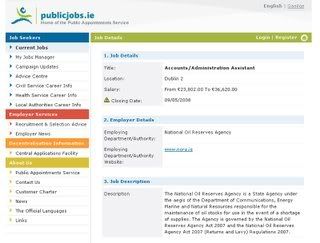
As one does, when one is an unemployed student and in need of desperate distractions when it is exam season, one desperately checks ones email for news tibets and humerous stories etc. So such was the case this morning when going through my email, I came across an email from the Public Jobs Commission advertising a new position within the Clerical Officer section. However, this particular job was for an Accounts i.e. Numbers, which means of course that this Arts Grad won't be going anywhere near it! :-). There is of course a twist, it was for NORA or otherwise known as the National Oil Reserves Agency.

Never heard of it? I'm not necessarily suprised I've not heard of it considering it has been in existence since 1995, when I was more interested in playing Doctors & Nurses in the Playground rather than worrying about National Oil Reserves. I am suprised though that considering all that has been ongoing within the Energy Industry over the last couple of years, that this particular QUANGO has not been more vocal about securing more Oil reserves etc.

I however have another question to ask though, according to NORA's own website,


"NORA receives no Exchequer funding..."


It Continues,


...its ongoing activities are 100% funded by a levy imposed on certain oil products
while it borrows from commercial banks in order to purchase NORA wholly owned
oil stocks. The levy (0.476 Euro cent per litre) has remained unchanged since
1995.


According to the Department of Communications, Marine and Natural Resources' website on NORA, the oil products which this levy applies to is as follows:


The oil products involved are petrol, kerosene, gas oil, DERV and fuel oils.
Details are also provided of the quantities imported and exported, wholesale
sales and purchases, and retail sales and own consumption, together with details
of any quantities used for marine or aviation purposes. The monthly levy due to
NORA by each company/consumer is calculated by the Department on the basis of a
company's retail sales plus own consumption, less sales to other oil companies,
less disposals of fuel for marine or aviation purposes.


So I guess my own inquisitive mind has a question? If NORA is only funded by a level of some 47 cent per litre and this funding is only acquired by the montly levy on the literage of "certain oil products", which includes petrol, keresane and fuel oils, Is this then contributing towards part of the reason why fuel costs in the Republic are quiet high? If roughly 47cent per litre is taken in a levy, it has to be passed on somewhere in order for Oil companies to make money. Invariably somebody has to take the hit for the levy and I would wager that this is possibly part of the reason for high fuel costs.


I don't dispute the necessity of requiring an Agency/Department to acquire oil stocks & Oil reserves in order to secure our own position etc but I am however more curious about is, the 47 cent per litre levy comes out of the above Oil products, is this all recycled back into NORA's own accounts for future purchases of Oil Reserves? According to its 2006 figures (Opens as a PDF), within it's Profit and Loss accounts it had some €37m in a turnover, with operating costs of some €29m in the same year?! This left it with some €7m of a surplus in that year. However the year previous, its P&L accounts has a recorded turnover of some €35m with operating costs of some €28m and coming out with a surplus of €24m? Like I said I am not an accountant but even I have queries about that. Perhaps it can be explained away with rising oil prices, rising risks and a worry about the longevity of current Oil reserves. Maybe then fair enough but still like, doesn't make it any less questionable as a Public Body under the Dept of Communications, Marine and Natural Resources, regardless of whether it recieves Exchequer funding or not.


Labels: , , ,

Friday, April 18, 2008

Beyond the Pale: National Photographic Archive

Modern plaque near Ballymore Eustace marks the southern extreme of the PaleImage via Wikipedia
A couple of weeks ago, I mentioned I was going to go to the Beyond the Pale exhibition in the National Photographic in Templebar. So Jeff and I had some time last week, so we popped in before Lunchtime to see what the was all about. For those of you who don't know where the Archive exhibition space is, it is located opposite the Information Centre in Templebar, behind the IFI.

So the exhibition. Well as the title itself suggests Beyond the Pale is to do with displaying images from the Lawerence Collection in the National Library of Ireland. The Lawerence Collection has been with the National Library since the mid 1940s and is one of the foremost photographic collections of Irish Social life at the turn of the 20th Century. This exbo however deliberates uses images from around the country from the late 19th and early 20th Century and hence the name "Beyond the Pale".

The cities featured in the exbo are Limerick, Derry, Belfast Cork, Galway and Waterford. It also features the town of Kilkenny (Yes I know I know but Kilkenny is not really a city and I'm writing this and I don't really care what the 2006 census says, it is not a City!). Overall Exbo is pretty well laid out and really easy to follow. Highly reccommended Viewing. Even if it is only placing streets in a modern context and trying to work out where everything goes now. Also alot of the images are crystal clear and save for the obvious dress differences with the subjects in the pictures, they could be quiet easily be confused for a picture which was only taken two weeks ago.

Labels: , , , , , , , , , , , , , , ,

Saturday, April 12, 2008

TV Documentary: BBC; Meet the Immigrants, Monday 14th April.

For those of you who have BBC, you may want to set your SKY+ boxes/VCR's for the following (Yes, they still exist and until a more affordable DVD Recorder comes onto the screen, the VCR will remain!!!) . Even though it will be from a British immigrant standpoint, it will be interesting to see if any similarities in the Experiences of Immigrants can be mirrored here. This is of interest given the current debate regarding the Immigration, Residency and Protection Bill 2008, whose contents is currently being hotly challenged by many NGOs and community groups, as well as some statutory agencies such as the Law Society.

Meet the Immigrants

Beginning Monday 14th April at 10.35pm on BBC ONE, running each Monday for six weeks.

Meet the Immigrants is a new, six-part observational documentary series, co-produced by The Open University, which looks at the lives of several members of the new wave of inward migration into the UK.

Narrated by David Morrissey, of Sense and Sensibility and Viva Blackpool, the series shows all sides of the real experiences of migrants in 21st century Britain; the daily challenges they face in arriving and surviving here, and providing welfare and economic security for their families, be they in the UK or overseas.

Meet the Immigrants also reflects the ongoing national debate on immigration and explores the common themes; industrious newcomers performing unskilled jobs that Britons won’t do, or opportunists in search of an easy life, attracted by the Britain’s flexible laws and systems.

On Open2.net there is an exclusive interactive world map which highlights key migration trends for selected countries across all continents. It displays which countries migrants to the UK come from, along with the issues they face there and the factors that made them decide to leave.


For more information about the series go to http://www.open2.net/immigrants/ or contact Polly Frazer on 01908 652 777 or mailto:OU.viewerandlistenerinfo@bbc.co.uk.

via Equal-L list.

Labels: , , , , , ,

NGO Concerns about the 'Immigration, Residency and Protection Bill 2008'

I Meant to post this a couple of weeks ago when I received the email but I forgot to! It is a Summary of Concerns regarding the Immigration Residency and Protection Bill 2008, which is currently being discussed within the Dáil. This Bill is very scary and the reliance within it of the Minister's Discretion to resolve the inconsistencies within the Bill, among other things, does not instill any hope about it either.


========
Via Equal-L
========

SUMMARY OF CONCERNS
NGOs working in the immigration sector believe the Immigration, Residence and Protection Bill 2008 represents an ideal opportunity to comprehensively reform outdated and inadequate immigration legislation. However, we believe the Bill, as it stands, fails to capitalise on this opportunity. If enacted without significant amendment, the legislation will seriously erode migrants’ rights while at the same time failing to address some of the serious flaws in the system, namely, unacceptable delays in the decision-making process, inconsistent decision-making, an over-reliance on the courts to resolve problems and a lack of clarity about the rights, entitlements and obligations of migrants in Ireland.
Key Concerns Immigration
With regards to Immigration, our major concerns about the Immigration, Residence and Protection Bill are:
  1. The Bill does not spell out clear rules regarding the rights and obligations of migrants coming to Ireland but, instead, it promises to ‘fill in the blanks’ later through the introduction of regulations. In fact, in some areas, the Bill fails to say who may come to Ireland and under what conditions, something we believe is fundamentally important in primary immigration legislation.
  1. The Bill does not provide for an independent appeals mechanism for immigration decisions, as promised in the Programme for Government. As a result, we believe the Government’s reliance on the courts as a mechanism for resolving challenges to decisions will continue and probably intensify, at significant cost to taxpayers and great personal cost to migrants.
  1. According to the European Commission, family reunification is one of the most significant types of migration to the EU. Unless the Bill is amended, Ireland will be the only EU Member State which does not have primary legislation covering this very significant type of migration.
  1. Provisions in the Bill for summary deportations may result in vulnerable people, who have become undocumented through no fault of their own, being deported before they can regularise their situation, leaving them with no avenue to make an application for residency even where their case involves very exceptional circumstances. Additionally, if not amended, this provision could result in migrants being unable to avail of programmes which help them return voluntarily to their country of origin, meaning taxpayers will pay for a larger number of people being forcibly removed the State.
  1. Sections of the Bill may be unconstitutional and breach Ireland’s international human rights obligations. One example is new restrictions on people’s right to marry, which bans some migrants from marrying in Ireland – even if they are intending to marry an Irish citizen – unless the Minister exercises his discretion and gives his permission.
  1. The Bill restricts migrants’ access to justice in a number of ways. Two examples are: allowing just 14 days to initiate judicial review proceedings in response to any immigration decision and allowing for the courts to award costs against a migrant’s legal representative personally, something we believe to be intimidatory and unconstitutional.
  1. While the Bill gives ‘long-term residency’ a statutory footing, unlike most other EU countries, Ireland’s version of this status will not be permanent and will be granted at the discretion of the Minister.
  1. We have grave concerns about provisions designed to provide protection to victims of trafficking. Most significantly, people who are trafficked to Ireland from within the EU will not benefit in any way from these provisions as the Immigration, Residence and Protection Bill generally applies only to citizens from outside the EEA.
  1. The Bill denies access to benefits and services to migrants who are ‘unlawfully present’ in Ireland. Unless amended, one example of what this would mean is that a migrant who has become undocumented as a result of workplace exploitation would not be able to seek redress through the Employment Appeals Tribunal.
  1. There is an inherent tension in the Bill in that it combines general immigration and asylum/protection issues in the same piece of legislation. Parts of the legislation are extremely problematical in that people entering Ireland for the purpose of seeking asylum are subject to general immigration obligations and requirements.
Potential Breaches of the Constitution
· Section 4 (8) of the Bill, which introduces summary deportation, may be in breach of fair and just procedures – an unremunerated right recognised under the Irish Constitution. May lead to violations of the right to private and family life as protected by Article 8 of the European Convention on Human Rights and has the potential to breach Article 6 and 13 of the European Convention on Human Rights.
· Section 123 (2)(b) of the Bill, which prohibits the marriage of certain foreign nationals in the State, even where they wish to marry an Irish or EU national, may be in breach of the constitutionally protected right to marry in Article 41.3.1
· Section 123 (3) of the Bill, which relates to possible exemptions from the prohibition to marry in Ireland, may breach the equality clause in Article 40.1 of the Constitution be in breach of 15.2.1 of the Constitution which provides that the Oireachtas has the sole and exclusive power to make law.
· Section 118 (8) of the Bill, which would introduce the possibility of the High Court awarding costs against migrants’ legal representatives, but not against the State’s legal representatives, may breach Article 40.1 of the Constitution.
· There is a real question whether the restriction of the High Court’s ability to extend time in judicial review proceedings beyond the 14 days migrants have within which to initiate judicial review proceedings against immigration decisions, contained in Section 118 (3) of the Bill, may also be unconstitutional.

Potential Breaches Of International Human Rights Obligations
· Section 118 of the Bill, which would introduce the possibility of the High Court awarding costs against migrants’ legal representatives, but not against the State’s legal representatives, may breach Article 6 of the European Convention on Human Rights and Fundamental Freedoms.
· Failure to provide for an independent appeals mechanism for immigration decisions, as promised in the Programme for Government, may deny migrants the opportunity to challenge decisions affecting their, and their families’, human rights, as protected under the European Convention on Human Rights and Fundamental Freedoms, in particular Articles 3 and 8, may be in breach of Articles 6 and 13.
· Section 4 (8) of the Bill, dealing with summary deportations, may lead to violations of the right to private and family life as protected by Article 8 of the European Convention on Human Rights and has the potential to breach Article 6 and 13 of the European Convention on Human Rights.
· Provisions in Section 124 of the Bill, relating to protection for victims of trafficking, fall far short of Ireland’s obligations under the Council of Europe Convention on Actions to Combat Human Trafficking:
- Most significantly, the protective measures contained in the legislation would not apply to EEA citizens who have established their free movement rights and with that exclude people who have been trafficked into Ireland from within the EEA from protection.
- Another major concern is the absence of provisions detailing the
types of assistance which would be made available to people who
have been identified as victims.
- Additionally, temporary residence permits for victims would be issued only if linked to the victim assisting a prosecution and does not take into account circumstances where the victim may be too traumatised to take part in prosecutions, or where the State decides not to proceed with prosecutions.

Key Concerns Protection
NGOs working in the protection sector welcome the publication of the Immigration, Residence and Protection Bill 2008 but believe that in its current format it misses the opportunity to address the fundamental flaws in our immigration and protection system. There are concerns that a number of provisions remain inadequate in fulfilling Ireland’s obligations under international human rights law. Unfortunately, the Government has confused immigration policy – of which parts deal with who enters the state, the necessary documentation required and the manner whereby they do so – with the right to seek protection. Asylum seekers arrive with the intention of seeking refugee or other protection status, as laid down under international agreements, and this should not be confused with other immigration issues. It is imperative therefore that the Government recognises that people fleeing persecution have a right under international law to seek protection and a right to have their claim for protection determined in a fair and open way, by ensuring that the appropriate checks and balances are in place to make sure that people’s rights are not violated in any way. In addition, the proposed asylum and protection system continues to lack transparency and remains outside the scope of the Freedom of Information Act, re-enforcing the secrecy under which it is currently clouded and remains outside the scope of the Freedom of Information Act making it hard to see that justice is done. It is also extremely disappointing that in launching this Bill the Minister has adopted a culture of disbelief by choosing to question the fundamental principle of access to justice and the importance of maintaining full judicial oversight of any decision that directly affects Ireland’s compliance with its international legal obligations. Such a culture not only negatively frames the debate surrounding the Bill but also if passed into legislation will have the same negative implications for those tasked in ensuring its application. We sincerely hope that the Government and opposition parties take into account the concerns of the NGOs, the UNHCR and the Irish Human Rights Commission to correct the current shortcomings.
With regards to Immigration, our major concerns about the Immigration, Residence and Protection Bill are:

1. Access to procedure/access to territory

The right to arrive in the country and seek protection is absolutely fundamental in international law, and should not be limited by provisions which are designed to control immigration for work or other purposes. We note with concern that the Bill provides no clarity on the position of protection and does not properly reflect and ensure respect for our obligations under international refugee and human rights law. The Bill should contain specific references to and affirmation of the absolute respect of the right to seek asylum, and reiterate that Ireland’s international obligations are engaged as soon as an asylum applicant arrives at our border or is on the territory of the State. The Bill makes it an offence to try to enter the State without a passport or other identity documents and without a pre-entry permission. This may not be compatible with Article 31(1) of the 1951 Refugee Convention which provides that the State should not impose penalties for unauthorised entry, provided that a refugee presents him/herself without delay to the authorities and shows good cause for his or her illegal entry. It is an important safeguard aimed at allowing persons in need of protection to do so where they cannot obtain travel documentation and States must not punish those asylum seekers who have no choice but to present at the State’s border on an unauthorised basis or improper documentation.
Carrier liability improperly shifts responsibility for protection decisions from the State to carriers. Carrier sanctions will mean that those seeking protection may be prevented from accessing the State, in breach of the State’s obligations under the 1951 Convention. This may well have the effect of forcing persons to rely on traffickers/smugglers. At minimum, the State should allow for an asylum/protection-related defence to carrier liability and exempt carriers where persons make protection applications upon arrival to Ireland and/or where persons are particularly vulnerable (i.e. trafficked persons and separated children).

2. Single Decision Process/First Instance

We welcome the principle of a single-decision process for all forms of protection, to assess claims for asylum, subsidiary protection, non-refoulement and compelling reasons. We do, however, have concerns about the current processes, including the lack of legislated Rules/Guidelines, and the use of accelerated procedures. We are disappointed that the Bill has not been amended to provide for official records of proceedings (rather than a summary kept by the interviewer), or the publication of decisions, both of which we would consider to be good practice internationally. Further, concerns regarding the lack of clarity around the role of the observer (s. 74 (9)), and disclosure to the applicant regarding the evidence to be relied upon by the State have not been addressed. (Note: We are encouraged, however, by the requirements of s. 75 (2) and 81 (c) (i) and (ii)). We would further welcome if explicit reference was made inter alia to the 1951 Convention in the legislation. This would be in line with the objective as outlined in the preamble of the Qualifications Directive to determine refugee status in line with the 1951 Convention.

3. Qualifications Directive and Procedure Directive and Interpretation in Bill

It is in the State’s best interest in terms of efficiency and also to recognise and uphold obligations to those in need of international protection that all forms of international protection needs are examined in a single procedure, with the same minimum guarantees that are in line with international human rights law and standards. The grounds for protection, including the relevant standard of proof, should be interpreted in the light of existing and evolving jurisprudence of international human rights law and the European Court of Human Rights. With regard to the definition of serious harm, as outlined in the Qualification Directive as transposed by S.I. No. 518 of 2006 European Communities (Eligibility for Protection) Regulations 2006, we would like to highlight concerns raised by UNHCR and others that the notion of an ‘individual threat’ should not lead to the imposition of an additional threshold for those facing a serious threat to their life or person because of indiscriminate violence. If there is a serious threat it is, by definition, a threat to the individual, even if they are not specifically targeted. We also recommend that the Government ensure that this is interpreted broadly so that protection is provided to those who have fled serious threat to their life or person, including indiscriminate violence and gross human rights violations outside the context of ‘internal or international armed conflict’.

4. Safe Third Country/Country of Origin

It is concerning that Section 102 of the Bill allows for the possibility to designate a part of a country of origin as safe. The Bill provides additional criteria to that currently provided for in the Refugee Act 1996 by which a country must be assessed in order to be designated a safe country. The Bill provides that a safe country of origin designation can be made if the Minister is satisfied that, on the basis of the legal situation, the application of the law within a democratic system and the general political circumstances, it can be shown that, in the country or part of the country concerned, there is generally and consistently no persecution, construed in accordance with sections 64 and 65, no torture or inhuman or degrading treatment or punishment and no threat by reason of indiscriminate violence in situations of international or internal armed conflict. There is no such criteria in the Refugee Act 1996. In addition, declaring countries as generally safe, or parts of countries safe without a proper examination of the individual circumstances of a claim is at odds and is inconsistent with the proper focus of international refugee law on individual circumstances and the protection needs of individuals. Therefore the individual circumstances of an applicant must not be ignored in favour of a generalised determination of safety of a country of origin or part of that country. Again the Qualification Directive, as transposed by S.I. No. 518 of 2006 European Communities (Eligibility for Protection) Regulations 2006, underlines the concept that individual circumstances of the applicant must be considered (Article 4(3)). The addition of clearer criteria in the 2008 Bill is to be welcomed.

5. Protection Review Tribunal (“PRT’)

We welcome the Minister’s assurances that the protection appeals process will be more transparent and fairer than that provided by the current Refugee Appeals Tribunal (“RAT”). However, as currently drafted, the proposed PRT is effectively the same body as the Refugee Appeals Tribunal (“RAT”), save in name. Only selected decisions of the PRT will be published, despite internationally recognised best practice (including in the UK) providing for publication of anonomysed decisions. The Chair of RAT is deemed the Chair of PRT. The Chair can delegate key duties to others. The Chair may produce public Rules and may produce internal Guidelines to be relied upon by the Members. We would urge that the legislation be amended to provide for publication of decisions (suitably anonomysed), to require the Chair to publish Rules and Guidelines and to remove s. 95 (7)(a), which undermines the lawyer’s role and duty in representing their client.

6. Protection for Suspected Victims of Trafficking

We welcome the inclusion of a new section on the protection of suspected victims of trafficking. In our view, however, this provision needs to be further developed to facilitate ratification of the Council of Europe Convention on Action against Trafficking in Human Beings and the UN Trafficking Protocol. In particular, specific provisions relating to the protection of suspected trafficked children and the specific entitlements of those who are granted temporary residency should be added. Furthermore, additional good practice measures should be seriously considered, such as a non-punishment clause and the possibility to grant temporary residency on humanitarian grounds, whether or not the victim is in a position to co-operate with the authorities. Trafficked persons should be exempted from the pre-removal powers of detention provided in the Bill. An explicit recognition of the right of trafficked persons to seek international protection and to have access to free legal aid should be included.

7. Protection for Separated Children

We are disappointed that no new provisions have been included to improve protection for separated children, given the concerns about the shortcomings in the current system outlined in our previous submission and in the recent recommendations of the Special Rapporteur on Child Protection. Separated children are entitled to protection, and measures should be put in place to improve identification, age assessment, registration, family tracing, guardianship, best interests determination, treatment and care. In our view, there is a need for a specific new provision, in line with Ireland’s obligations under the Convention on the Rights of the Child (as outlined in General Comment No. 6) to comprehensively address these issues and provide for the granting of long-term residency when that is deemed to be in a separated child’s best interests.

8. Family Reunification

The Bill provides a statutory right for refugees and persons granted subsidiary protection to apply for family reunification (Section 50). However, the definition of ‘family’ is too narrow, Minor refugees are not allowed to apply for their siblings, which can place parents in an unacceptable dilemma of whether to join their child in Ireland or remain in their country of origin with their other child/children. Only spouses are included and not unmarried partners even if they can prove a long term relationship. The Bill fails to address the rights of family reunified persons in the event of death or marriage breakdown. In addition it fails to provide for the right of appeal for those whose applications for family reunification have been unsuccessful.

9. Detention

We were disturbed to see that increased powers of detention have been added to the 2008 Bill, for example, in section 70 (1), (2) and (3). There is now provision in the Bill to detain persons at every stage of the protection process. As the legislation stands, a person seeking protection could be detained from their point of arrival to their point of removal. There is also the possibility of detaining children in violation of the Convention on the Rights of the Child. We would strongly urge consideration of alternatives to detention, noting UNHCR Guidelines, which allow for detention only in exceptional circumstances and for minimal periods.

10. Deemed Withdrawal/No Appeal Rights

There are no appeal rights where a protection application is deemed withdrawn (whether at first-instance or upon appeal). This seems to be inconsistent with the Procedures Directive, Article 39 (1), which states: “Member States shall ensure that applicants for asylum have the right to an effective remedy before a court or tribunal against… (b) the refusal to reopen the examination of an application after its discontinuation (pursuant to Articles 19 and 20 of the Directive).” Further article 20(2) of the Directive requires States to ensure that an applicant is entitled to request that his or her case is reopened following a discontinuation. (Section 89 of the Bill, as currently drafted, is unclear as to its impact on this crucial question, which goes to the heart of protection against refoulement for this issues).

11. Leave to Remain/Humanitarian Considerations

As outlined in the Bill, protection applicants who are not entitled to protection in the State may be granted residence permission as per Sections 79 (2) (c) and 83. However, in those sections, humanitarian considerations are not listed and it is unclear who would meet the ‘compelling reasons’ criterion and whether or not residence criteria (at Section 31) will also be applied. We are concerned that vulnerable persons who are now granted leave to remain status as well as those who cannot be refouled may be denied residence permission under the terms of the Bill, particularly if the residence criteria are applied.

12. Refoulement

The combination of the Dublin Regulation rules and the safe-third-country and safe-country-of-origin concepts, as well as rules on carrier sanctions and transporters' liability, limited access to interpreters and lawyers and the lack of suspensive effect of certain appeal procedures constitute a threat to the principle of non-refoulement. (See European Parliament Resolution A5-0451/2002 of 15 January 2003 Report SWIEBEL (2001)). Also, provisions relating to the breach of conditions leading to revocation and Section 97(11) (c) (obligation to remove oneself and power of removal without notice) increase the risk of refoulement.

13. Procurement and Exchange of Information

There are a variety of provisions in the Bill regarding the procurement and exchange of information. In this regard, we stress the need for consent, confidentiality and data protection. We would like to seek clarity on the necessity, nature and implications of some of these provisions including stated restrictions on the application of the Data Protection Act and Freedom of Information Act. With respect to the acquisition of information, children should not be required to furnish biometric data without their consent and the consent of their guardian. Age assessment measures should be in line with the minimum standards outlined in the Procedures Directive.

14. Judicial Review

Access to Judicial Review, which provides crucial judicial oversight of the asylum process, is severely curtailed by s.118. Given the role that judicial review plays in the Irish legal system, in safeguarding compliance with the Irish Constitution and requirements of due process, we would ask that these be reconsidered. Access to judicial review is an important marker of a State based on rule of law. In particular, s.118(7) should be removed, given its potential to deter lawyers from seeking the remedy of judicial review. Strict time limits and constraints are already in place, given the ‘substantial grounds’ requirement and 14 day time limit introduced in the Illegal Immigrants (Trafficking) Act. The additional restrictions imposed in s.118 (3) could potentially remove an important check on the asylum process. As we have seen to date, such checks and balances are essential to ensuring that the asylum process meets the standards that legislation and policy seeks to achieve. These restrictions may also contravene article 13 of the ECHR, which provides a right to an effective remedy, including where non-refoulement rights in article 3 may be threatened. We would hope that improved procedures and greater transparency in the process would reduce the numbers of applications for judicial review proceedings.

15. Training of Immigration and Refugee and Protection Status Determination Officers

We are concerned that there is no explicit reference underlining the importance and need for rigorous, comprehensive and ongoing training for any officer undertaking immigration duties and protection assessments, strict guidelines, and minimum criteria for the recruitment and training of officials and effective safeguards setting out the requirements of human rights law and standards, as required by the EU Procedures Directive. Guidelines and specific provisions that address the special needs of vulnerable persons, including survivors of violence, in particular sexual violence and torture, and traumatized asylum-seekers should be introduced. Failure to adequately train all officers could potentially represent a serious risk of flawed decisions and non-compliance with the requirements in EU asylum provisions, especially in relation to the Qualification Directive as transposed.

16. Monitoring

In order to ensure compliance to our international obligations, it is imperative that independent monitoring and quality assessment mechanisms, such as that of the UK Quality Initiative Project developed by UNHCR, should be established and given access to randomly selected samples of files in order to assess the quality of decision-making, identify gaps in existing decision-making procedures and address the appropriate training and resources needed to fill these gaps. In this way issues and weaknesses could be identified and corrective advice provided and the publication of these reports would ensure transparency and accountability
Contact Details for Further Information:
Integrating Ireland
17 Lower Camden Street, Dublin 2
Tel: +353-1-4759473
Refugee Information Service
18 Dame Street, Dublin 2
Tel +353-1- 645 3070
Website: www.ris.ie
Immigrant Council of Ireland
2 Saint Andrew Street, Dublin 2
Tel: +353-1-6740202
Migrant Rights Centre Ireland
55 Parnell Square West, Dublin 1 Tel: +353-1-8897570
Website: www.mrci.ie


Irish Refugee Council
88 Capel Street, Dublin 1
Tel: +353-1-8730042


Labels: , , , , , , ,